At Aramark Canada, we believe meaningful partnerships create opportunities that extend far beyond business. One example is our relationship with Staff Shop, a certified Canadian Indigenous and women-owned people strategy firm providing staffing and payrolling, executive and professional search, and people strategy consulting across Canada.
Staff Shop connects Indigenous and non-Indigenous talent with meaningful employment opportunities while helping organizations build stronger, more inclusive workplaces. Its culturally informed, strategy-first approach considers the whole person, the workplace environment, and the systems required for people to belong, perform, and grow.
More than a recruitment provider, Staff Shop is a valued partner in advancing workforce inclusion, economic participation, and sustainable career pathways. Built on mutual trust, creativity, shared values, and a commitment to long-term impact, the partnership reflects Aramark Canada’s dedication to reconciliation through meaningful relationships and opportunity creation.
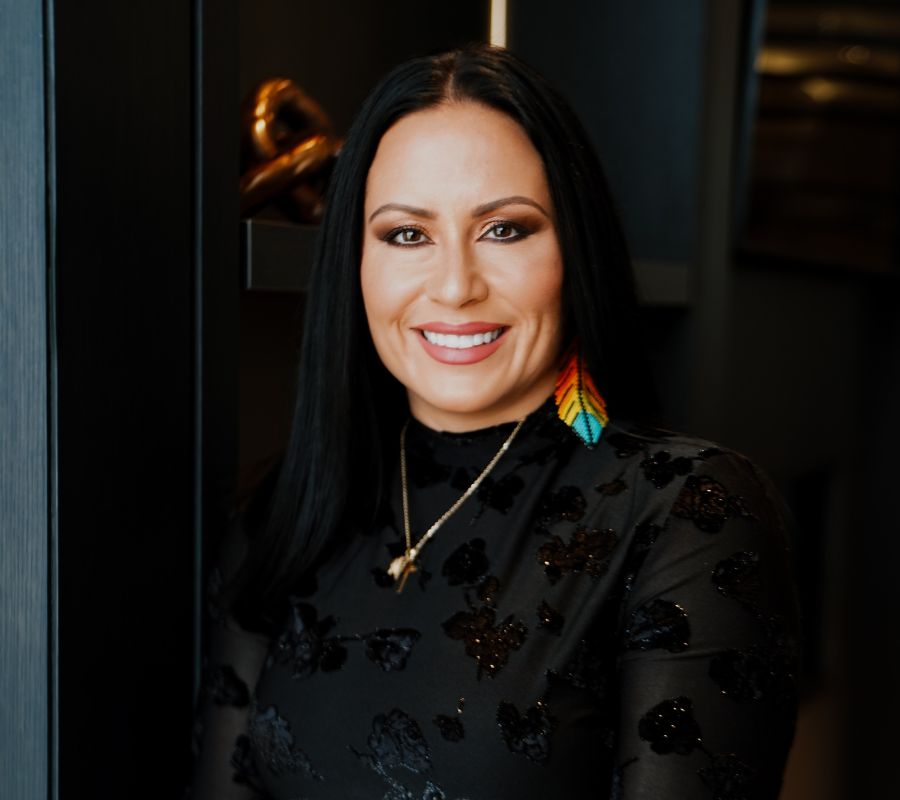
We spoke with First Nations Ojibwe & French Canadian Jennifer Ménard-Shand, Founder and CEO of Staff Shop, about the company’s mission, its long-standing relationship with Aramark Canada, the importance of Indigenous employment, and the role businesses can play in moving reconciliation forward.
Q&A with Jennifer Ménard-Shand
Can you tell us about Staff Shop and the mission that drives your work?
Staff Shop exists to multiply leaders and legacies that make the world a better place. Our purpose is to lead with faith, serve with love, and reflect God’s heart through business, and our vision is to create legacies worth emulating for generations to come.
Our mission is to build an army of servant leaders who raise industry standards The Staff Shop Way. We bring that mission to life as a certified Indigenous and woman-owned people strategy firm. We support organizations through three connected service lines: Staffing & Payrolling, Search Solutions, and People Strategy. That means we can help a client fill an immediate workforce need, find a critical leader, or step back and address the deeper systems, culture, leadership, and talent-strategy issues affecting long-term performance.
At the centre of everything we do is a simple belief: business is about people. When people feel seen, valued, and aligned with work that fits their strengths and purpose, they are happier, they perform better, and organizations and communities become stronger.
What inspired the creation of an Indigenous-owned recruitment agency focused on connecting people with meaningful employment opportunities?
Staff Shop did not begin as a traditional start-up. It was incubated within The Bagg Group, where I spent nearly a decade learning from my mentor, Geoff Bagg, who I often call my Yoda. I entered the staffing industry in 2008 and later built Bagg’s first hospitality division, drawing heavily on my earlier experience working in hospitality at Maple Leaf Sports & Entertainment.
Aramark was one of the original hospitality clients I supported under The Bagg Group umbrella. That relationship helped inspire me to keep growing in the hospitality and workforce space because I could see how much the right people affect the guest/employee experience and the success of an operation.
When The Bagg Group was sold in 2018, I acquired the division I had built and evolved it into Staff Shop. The company reflects everything I learned through that journey, but also my own lived experience. Employment was an important pathway to independence, dignity, confidence, and freedom in my life. I wanted to build a firm that could create those same pathways for others while helping employers become more thoughtful, strategic, and inclusive.
Staff Shop is known for its culturally informed approach to recruitment. What does that look like in practice, and why is it important?
For us, culturally informed recruitment starts with strategy. Recruitment should be the outcome of good strategy, not a substitute for it. Organizations sometimes come to us asking for Indigenous talent or wanting to improve representation, but if the workplace systems, leadership practices, onboarding, policies, and employee experience are not ready to support those individuals, simply filling a role will not create lasting change.
That is why we built a People Strategy service line. We partner with clients to understand the underlying issue before rushing to a hiring solution. We look at culture, leadership, retention, workforce planning, values, succession, inclusion, and the barriers that may be preventing people from succeeding.
Our approach is grounded in listening rather than making assumptions. We take time to understand each person’s experience, values, strengths, community connections, and goals, as well as the realities of the workplace they may be entering. Culturally informed recruitment is not about lowering standards, checking boxes, or filling quotas. It is about protecting merit while removing unnecessary barriers, recognizing different forms of knowledge and experience, and building systems that allow people to thrive long after the hiring decision is made.
How did your partnership with Aramark Canada begin, and what has made it meaningful for your organization?
Our relationship with Aramark goes back to approximately 2011, when Staff Shop was still being incubated within The Bagg Group and I was building the hospitality division. It is meaningful to see that relationship continue and evolve through Staff Shop more than a decade later.
Over the years, we have had the opportunity to support Aramark across several locations and workforce needs. What has made the partnership meaningful is the willingness to move beyond a transactional supplier relationship. Aramark has taken the time to learn about our business, include us in important conversations, and explore how we can create greater impact together.
Staff Shop has significant capacity and a strong desire to continue growing across Canada. We are also developing our U.S. and Caribbean expansion, and we would be proud to explore how we could support Aramark across North America. Long-term partnerships like this allow both organizations to become more creative and strategic about talent, representation, career pathways, supplier diversity, and shared growth.
Beyond filling roles, what impact can meaningful employment have on individuals, families, and communities?
Meaningful employment can change the direction of a person’s life. At the most practical level, it helps people put food on the table, care for their children, build stability, and make choices from a place of greater freedom. It creates confidence, dignity, references, relationships, and a sense of purpose.
People are usually looking for a hand up, not a handout. Equal opportunity means giving people the chance to compete and succeed based on their own merit, even when they may not have had equal access to networks, experience, or opportunity in the past. The impact extends beyond the individual to families, communities, and future generations through economic participation and visible examples of what is possible.
That commitment also shapes how we give back. Through my board work with Victim Services Toronto, I support an organization serving victims of violence and human trafficking. This is particularly personal because Indigenous women and girls are disproportionately affected by trafficking and violence across Canada. For Staff Shop, creating employment pathways, supporting community organizations, and helping people regain agency are all connected parts of the same mission.
Can you share a success story that reflects the value of creating pathways for Indigenous talent?
Talent Success Story: Staff Shop placed an Indigenous executive into the role of Vice-President, Nyaagaaniid, Anishinaabe Initiatives, Equity, Diversity and Inclusion at Algoma University. With more than 20 years serving Indigenous communities through law and governance, this opportunity enabled him to expand that impact through senior institutional leadership dedicated to strengthening Indigenous education, student success, and reconciliation for the next generation.
The impact extends well beyond one successful placement. In his role, he advances Indigenous student success, strengthens relationships with First Nations communities, and helps embed reconciliation throughout the university. This is the multiplier effect of creating pathways for Indigenous talent: when Indigenous leaders are positioned to influence systems and decisions, their experience and knowledge help open doors and create stronger pathways for future generations within Indigenous communities.
Client Success Story: One client example involves an organization that has been operating for more than 100 years. The organization had the best of intentions and hired an Indigenous leader, who then built an Indigenous team. However, the organization’s systemic and outdated structures made it difficult for that leader and team to succeed, and eventually the leader left along with the entire team.
Staff Shop was brought in to help the organization understand what had happened and rebuild more effectively. We helped modernize processes, policies, and procedures, and supported the client across all three of our service lines. The work was not simply about replacing people. It was about repairing systems, rebuilding trust, and helping the organization create a stronger foundation for long-term success. We continue to support the organization through an ongoing monthly retainer as a fractional people and HR partner.
Note: We continue to place Indigenous leaders across Canada into organizations and Indigenous communities who have direct influence in creating pathways for Indigenous Peoples. We are also working with clients who want to create intentional entry-level training grounds and career pathways into industries Indigenous talent may not otherwise have had easy access to. These industries have significant workforce needs and can provide meaningful, sustainable careers when employers are prepared to invest in training, support, and advancement.
From your perspective, what does a strong and respectful partnership between organizations like Staff Shop and Aramark look like?
A strong partnership is built on trust, transparency, creativity, shared accountability, and a willingness to learn from one another. It means involving Indigenous partners early, being honest about goals and challenges, paying fairly, sharing information, and measuring whether the relationship is creating meaningful outcomes.
It also requires sponsorship, not just mentorship. Mentorship offers advice. Sponsorship means putting your name and reputation on the line, opening a door, making an introduction, advocating for someone, and helping create the opportunity they need to prove themselves.
Sometimes moving reconciliation forward requires creativity, not just policy. The best partnerships are not performative or limited to a single initiative. They grow because both organizations are willing to think differently, solve problems together, and create value for individuals, clients, communities, and the broader economy.
What role can employers play in creating more inclusive workplaces and supporting Indigenous career growth?
Employers need to consider the full employee journey, from outreach and recruitment to onboarding, development, promotion, succession, and retention. Hiring someone is only the first step. The workplace must also be designed so that person can belong, contribute, and grow without leaving their identity at the door.
One of the tools we use is the Core Values Index™, or CVI™. It helps identify a person’s innate core-value energies and how they are naturally wired to contribute. When people are aligned with work that fits those strengths, they are more likely to be engaged, happy, productive, and successful over the long term. The CVI™ has proven to increase productivity by up to 300% as the only assessment tool with a repeat reliability score of 97% compared to others who average between 60-80%. Staff Shop is Canada’s Master Distributor of this life changing assessment which is designed to attract, develop and retain A players.
This is part of our broader Competency Compass approach. We do not want to place people into random roles simply for the sake of filling a vacancy or meeting a representation target. We want to understand the person, the role, the leader, and the environment so the match has the best chance of lasting. Inclusive employment is not simply about getting people through the door. It’s about creating the conditions for them to thrive once they are inside.
Looking ahead, what opportunities are you most excited about when it comes to advancing Indigenous employment and career development?
I am most excited about reconciliation in action. Truth and Reconciliation Commission Call to Action 92 specifically calls on Canada’s corporate sector to adopt the United Nations Declaration on the Rights of Indigenous Peoples as a reconciliation framework and to create meaningful change through business practices, education, employment, training, and long-term relationships.
That creates an enormous opportunity to move from awareness to action and from entry-level representation to full career pathways, leadership development, succession, procurement, entrepreneurship, and economic participation. I am excited about building systems that identify, develop, sponsor, and retain Indigenous talent at every level, including in the rooms where decisions are made.
This work is deeply personal to me. My personal mission is to break generational curses and empower leaders to do the same. I know what it feels like to experience oppression and limited opportunity, and I now have a much larger platform to help people and organizations create something different. Community is the why, systems are the how, merit should be protected, and shared growth is the outcome.
If there is one message you would like organizations across Canada to hear about Indigenous employment and inclusion, what would it be?
Do not approach Indigenous inclusion as an obligation, a communications exercise, or a box to check. Approach it as a relationship and as an opportunity to repair systems, build trust, strengthen your workforce, and create shared growth.
Reconciliation becomes real through everyday business decisions: who we hire, promote, buy from and sponsor, to whose voices we include, and whose potential we are willing to believe in before they have had the opportunity to prove it, which is what my Yoda did for me. Indigenous people bring talent, leadership, innovation, resilience, and perspectives that Canadian organizations need. Our job as leaders is to clear the path for them to grow.
Start with respect. Listen with humility. Protect merit. Build trust over time. Create meaningful opportunities. Moving reconciliation forward isn’t only about what we say. It’s about remembering our history so we don’t repeat it, honouring what has been entrusted to us, and building something together that is worthy of the next seven generations.